
.png?sfvrsn=6d0e27cd_1 "Partnership for Change - v7 (1)")


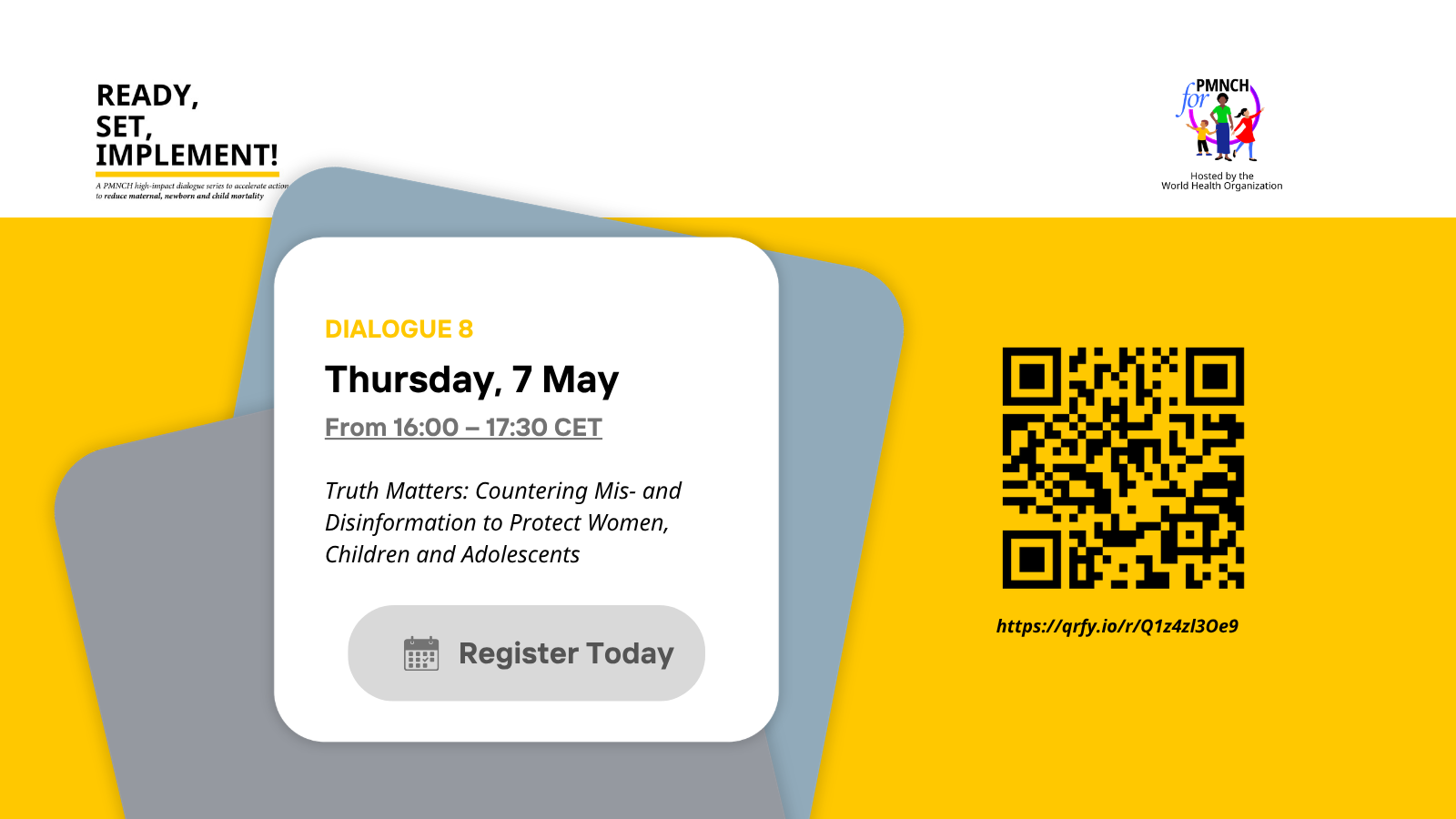
Mis- and disinformation are becoming a major barrier to progress for women’s, children’s and adolescents’ health. False or misleading content can undermine confidence in vaccines, distort understanding of sexual and reproductive health, delay care-seeking, and weaken trust in health workers and public institutions. In a fast-moving digital environment, harmful narratives can spread more quickly than evidence-based guidance, with serious consequences for health decisions and outcomes. Source
The stakes are high. Poor-quality reproductive health advice on social media can discourage contraceptive use, false claims about vaccine safety can undermine HPV uptake, and misleading mental health content can encourage unsafe self-treatment. WHO and UNICEF reported that in 2024 nearly 20 million infants missed at least one dose of a DTP-containing vaccine, including 14.3 million zero-dose children who did not receive a single routine vaccine. WHO Director-General Dr Tedros Adhanom Ghebreyesus warned that misinformation about vaccine safety, alongside drastic aid cuts, threatens to unwind decades of progress.
At the same time, there is growing evidence that practical solutions exist. In Ghana, UNICEF supported the establishment of a Misinformation Task Force with the Ghana Health Service and partners to coordinate daily monitoring, analysis and response to vaccine rumours, using trusted spokespeople, community-informed message design, local influencers and behaviourally informed approaches. In Moldova, UNICEF and partners have supported a youth-centred approach to addressing HPV misinformation, working with adolescents to co-create messages, strengthen peer education and improve trust around vaccination. These examples demonstrate that effective responses depend on listening, rapid analysis, credible evidence, trusted messengers and local ownership.
This Ready, Set, Implement dialogue will bring together public health leaders, technical experts and country practitioners to examine the effects of mis- and disinformation on women’s, children’s and adolescents’ health, explore practical response models, and introduce PMNCH FactCheck as a new initiative designed to support partners with rapid verification, expert-reviewed content and actionable response tools. In line with the purpose of the series, the session will focus on practical implementation: what the challenge looks like, what has worked in practice, and what partners can do now to protect health with evidence, trust and action.
Objectives
The session aims to strengthen partner understanding of how mis- and disinformation affects women’s, children’s and adolescents’ health; to present PMNCH FactCheck as a practical response mechanism; and to share country experience on strategies that help build trust, improve public communication and protect health outcomes.
More specifically, the webinar will:
examine the impact of misinformation and disinformation on SRHR, immunization, adolescent health and maternal mental health
present the rationale, design and use cases for PMNCH FactCheck
showcase country approaches to rumour monitoring, trusted messaging, peer engagement and rapid response
identify practical lessons for partners working to strengthen implementation and protect trust in health systems
Speakers
Rajat Khosla: Executive Director, PMNCH
Dr. Galina Lesco: Head of the National Resource Centre in YFHS NEOVITA and Executive President of the Health for Youth Association, Ministry of Health, Moldova
Brian Yao: Technical Officer, Hive Team, Community Protection and Resilience Unit, World Health Organization
Onikepe Owolabi: Vice President for International Research, Guttmacher
Nick Kimeta: Founder, Xhale Africa
Kadi Toure: Team Lead, Campaigns & Communications, PMNCH