
.png?sfvrsn=6d0e27cd_1 "Partnership for Change - v7 (1)")


The 5th CAAP Peer Learning Exchange, organized on 30th July 2025, was an opportunity for reflection, exchange and renewed purpose. It reinforced the value of CAAP as a platform for collective mutual learning and bringing together national partners to share challenges, good practices and strategic responses to the mounting pressures on sexual and reproductive health and rights (SRHR) and coalition building to advance women’s, children's and adolescents’ health.
As ideological, political and financial resistance to SRHR grows, country partners are using this space not only to stay connected and informed, but to actively shape advocacy directions through shared ownership. The exchange helped sustain momentum in difficult times and showcased how national coalitions can act as resilient engines of change, grounded in local realities and unified by a common cause. For example, Nigerian partners shared that the advocacy and accountability efforts for MNCH issues coordinated through the CAAP initiative have been recognized in the Government of Nigeria’s Voluntary National Review of progress towards SDG 3 and 5, and that one CSO representative partner will be invited to join and present at the RMNCAH+N core technical group meetings. Likewise, Kenyan partners ensured the institutionalization of civil society contributions to the implementation of the RMNCH Bill, aiming to strengthen accountability mechanisms, foster collaboration between parliament and civil society and place the voices and needs of communities at the center of policy and decision making.
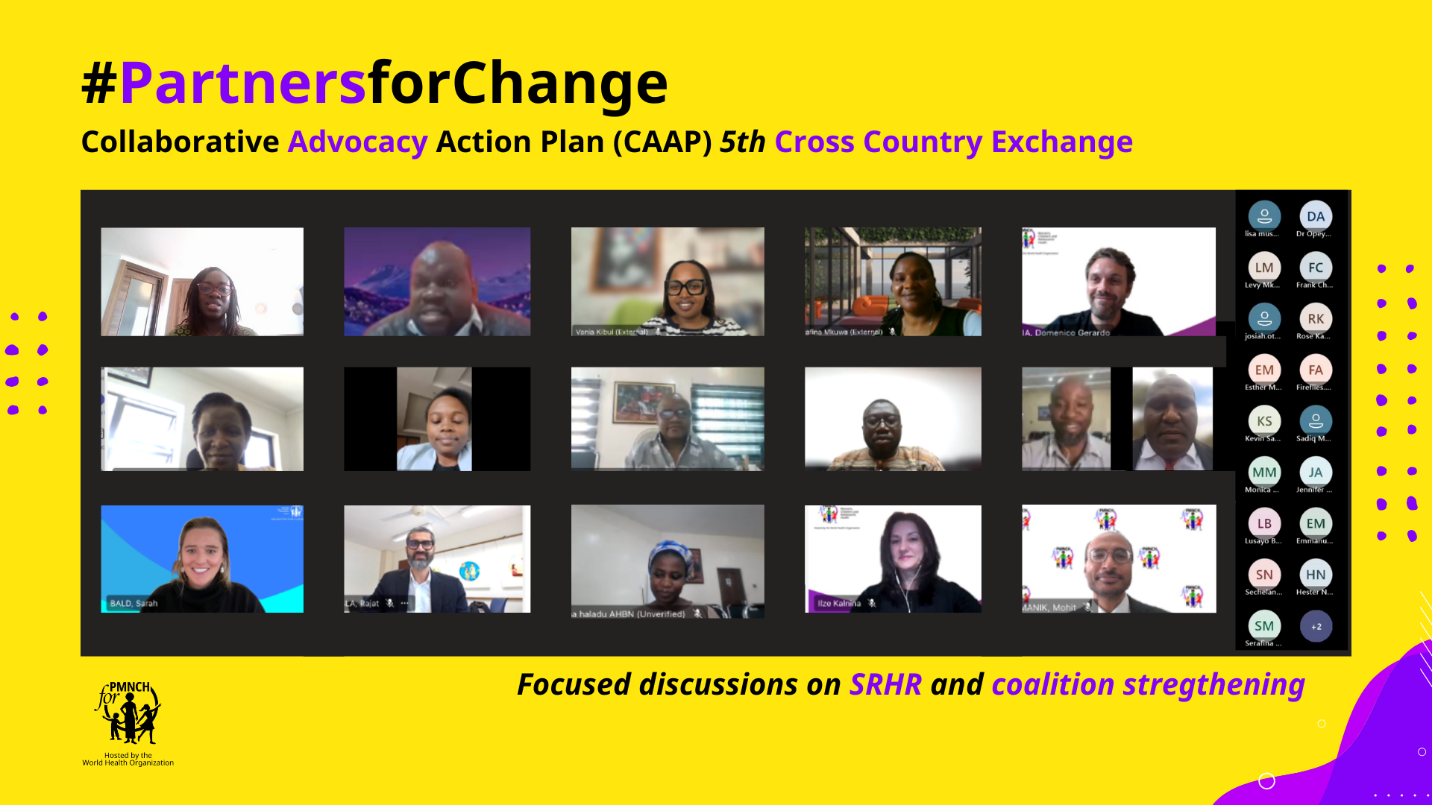
CAAP Coordinating Partners at the 5th CAAP Peer Learning Exchange
Confronting the SRHR backlash: A shared reality
Guided by the moderation of Solange Mbaye, Regional Programme Manager, Amref Health Africa West Africa, partners from across countries under the CAAP initiative underscored a sobering reality, yet opportunities at hand. As PMNCH Executive Director Rajat Khosla highlighted, the current moment is defined by a dual crisis: a steep erosion in both financial support and political will for SRHR. Laws and policies are regressing, while anti-rights rhetoric gains traction. Participants spoke of the politicization of SRHR issues, particularly adolescent health, leading to hesitancy or resistance among lawmakers and public officials.
Cultural taboos, misinformation campaigns, and strategic opposition by conservative actors are further narrowing the space for dialogue and reform. In some contexts, civil society actors may face real personal risk. Yet across the board, participants made it clear that they are doubling down on their commitments.
Local strategies, shared challenges
Country experiences revealed both the common threads and unique contours of resistance and action. SRHR topics are being increasingly weaponized in political arenas, discouraging parliamentary and government support. Across countries, comprehensive sexuality education and safe abortion remain highly contested, often framed as threats to cultural or religious values. However, advocates are finding ways to reframe the debate.
In Kenya, Lisa Mushega emphasized the importance of constructive engagement with religious leaders, avoiding confrontation while highlighting the health consequences of inaction. In Zambia, Levy Mkandawire illustrated how parliamentary champions can turn political directives into local action, such as the rollout of maternal waiting homes across constituencies.
Building collective advocacy through coalition strengthening
During a vibrant session on strengthening advocacy coalitions, participants emphasized that lasting advocacy impact comes not only from individual efforts but from collective capabilities with communities of advocates learning, planning and delivering as one. Drawing on the CAAP initiative, partners highlighted that sustainable change stems from shared ownership, open dialogue and strategic coordination. Insights from Tanzania and Malawi underscored the importance of aligning goals, mapping existing efforts and maintaining both coalition visibility and individual organizational identity. Designating CSO leads for specific objectives and rehearsing unified messaging were cited as tools to enhance coherence.
Participants also reaffirmed that inclusive alliances are essential in today’s resource-constrained environment. Experiences from countries such as Senegal, where gender parity reforms were enabled by broad coalitions, and Nigeria, where CSOs were integrated into national technical working groups, illustrated how joint advocacy efforts strengthen political legitimacy and accelerate progress. Youth engagement, voluntary contributions and structured platforms for joint action were identified as key to sustaining momentum and expanding impact.
Collective Strength for Sustainable Impact
Key lessons emerged during the two roundtable discussions, highlighting context-specific responses to persistent challenges, along with good practices that served to inspire and inform partners across countries.
Build inclusive, cross-sectoral coalitions.
From Ethiopia’s national Safe Motherhood technical working group to Nigeria’s engagement of faith-based actors, market women and people with disabilities, successful advocacy has relied on forging alliances beyond traditional health circles. Coalitions that bring together youth groups, religious leaders, legal professionals, and market women have proven effective in amplifying messages and legitimizing calls for reform.
Align on shared goals and clear roles.
As seen in Malawi and Tanzania, mapping existing efforts and assigning clear leads to advocacy objectives ensures coherence and avoids duplication. Internal coordination, consistent and aligned messaging and mutual respect for each organization’s identity are essential to strategically positioning key advocacy issues to influence decision makers.
Leverage local evidence and ‘front’ personal stories.
Localized data on the socio-economic impact of adolescent pregnancies, unsafe abortions and maternal mortality remain powerful tools for framing SRHR as a public health, social and economic imperative. But as Amref Health Africa Malawi’s Hester Nyasulu reminded participants, stories from affected individuals, especially young women, can often resonate more deeply with decision makers than statistics alone. Dr. Frank Chikhata from Clinton Health Access Initiative in Sierra Leone, also underscored the importance of engaging communities to co-create advocacy messages and human-centered stories, which resonate more powerfully with decision makers and influencers, especially at the subnational level.
Engage high-level champions as well as community allies to shift the narrative.
Partners underscored the importance of engaging high-level champions and their networks as well as grass-roots actors. Whether through religious leaders, male guardians, or traditional authorities, several country partners are working with trusted messengers to dismantle taboos and reduce opposition.
Institutionalize advocacy efforts.
In several countries, integrating CSOs into high-level technical groups has helped institutionalize these efforts, thereby raising the awareness of key decision-makers on issues that required urgent action and build long-term accountability.
Foster ownership and sustainability through collective capabilities.
Partners underscored the power of coalitions to learn, plan, and act together. Sustainable advocacy is rooted in trust, shared leadership, and the ability to align local priorities with broader policy goals.
Capture and share success stories.
While challenges and contexts differ significantly, lessons can be learned from the successful experiences of other countries and partners in advocating for WCAH issues. It is critical to capture and actively share these experiences among partners, and avoid duplicating work.
Moving forward: From resistance to resilience
The 5th Peer Learning Exchange reaffirmed that while the challenges facing SRHR are consistent, they are not insurmountable. As stated by Ilze Kalnina, Team Lead, Political Advocacy at PMNCH, at the outset of the event, at the core of PMNCH’s support to CAAP countries is a stronger, more unified coalition approach that builds on local contexts and lived experiences.
In a time of shrinking resources and escalating needs, the community of CAAP coordinating partners is showing what it means to move from challenges to solutions: stronger coalitions, a unified voice, a shared mission, and diverse approaches to protect the health and rights of women, children, and adolescents.