
.png?sfvrsn=6d0e27cd_1 "Partnership for Change - v7 (1)")


As part of its ongoing cooperation with Inter-Parliamentary Union (IPU), PMNCH actively participated in the IPU Assembly in Geneva, Switzerland from 13th -17th October 2024. The IPU Assembly is a biannual convening of IPU statutory bodies, including the Governing Council, Standing Committees, Committees on the Human Rights of Parliamentarians, as well as the Forum of Women Parliamentarians and the Forum of Young MPs to deliberate on key strategic and programmatic issue including identifying future priority areas of action by member parliaments. The central theme of this Assembly was "Harnessing science, technology and innovation (STI) for a more peaceful and sustainable future". The Geneva Declaration, which captures the outcomes of the general debate, has a strong equity focus, and gives visibility to the needs and considerations of women, young people and groups in vulnerable or marginalized situations in creating, developing, deploying and utilizing science, technology and innovation for the common good. The resolution is mindful to, both, the imperative of ethically maximizing the potential of these technologies as well as mitigating the risks, including the impacts on the well-being of youth.
The PMNCH delegation actively participated in the discussions of the Assembly and IPU Governing council and conducted a series of bilateral meetings to:
- raise the visibility of WCAH issues in topics being discussed in the general debate, resolutions passed by the 149th Assembly and relevant discussions of the standing committees,
- contribute to the technical work of the IPU and Parliaments on health, and
- deepen prospects for collaborating with parliaments on women, children and adolescent health (WCAH) issues.
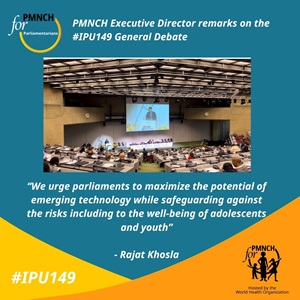 PMNCH engaged in several formal sessions of the Assembly including:
- the General Debate,
- the discussions during the Fora of Women Parliamentarians and Young Parliamentarians, and
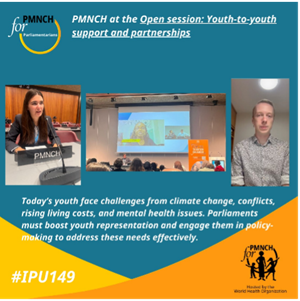
- the Open Session organized by the Forum of Young MPs to commemorate its 10-year anniversary.
Furthermore, PMNCH contributed to the proceedings of the Advisory Group on Health, the gender parity debate, co-organized a workshop on SRHR, as well as participated in 2 workshops on parliamentary actions to prevent democratic backsliding and the use of data and evidence for decision making and accountability, respectively.
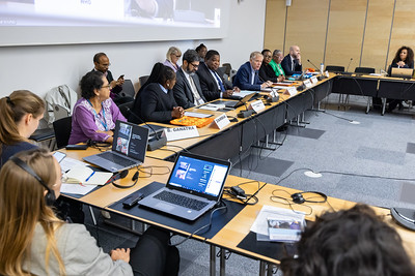
During the workshop on health, parliamentarians from around the world shared examples of how they are working to advance SRHR issues
An important event of note was the workshop, titled "Can parliaments tip the balance for sexual and reproductive health and rights?" which was organized jointly by the IPU, the WHO, and PMNCH. The interactive workshop examined the role of parliamentarians in protecting and promoting SRHR, in these politically charged times and in the midst of compounding national crises (related to climate change, conflicts and rising cost of living). Interventions from parliamentarians who shared the challenges and opportunities to take action on SRHR issues in their countries gave light to the realities of the ground and, therefore, the importance of approaching these issues from a justice and rights perspective in order to be able to take meaningful action despite the multiple crises confronting societies today. It was illuminating to hear about the steps taken by the Gambian Parliament to uphold the ban on FGM which faced a threat to be repealed and the ongoing realities despite the ban being upheld. During the March Assembly, PMNCH and IPU leadership had collaborated on this issue, including releasing a joint statement that has been widely disseminated by several media outlets, urging the Gambia to uphold the ban on FGM.
 Based on PMNCH’s efforts to ensure that the rights and needs of vulnerable and marginalized groups particularly women, children and adolescents are taken into account in this era of rapid scientific and technological advancement, PMNCH collaborated with like-minded parliamentarians to strengthen the resolution on The impact of artificial intelligence on democracy, human rights and the rule of law such that it recognizes the specific vulnerabilities of women, girls, and youth to the impacts of emerging technology and, therefore, the importance of meaningfully engaging these population groups in the processes to create, develop and deploy these technologies.
PMNCH applauds the unanimous passage of the emergency resolution titled, Response by parliamentarians to the urgent plea by the UN Secretary-General to recommit to multilateralism for global peace, justice and sustainability which calls for concerted multilateral efforts and the upholding of multilateral frameworks to address global challenges confronting the international community, such as gender discrimination, the undermining of women’s rights as well as the insidious impact of war on women and children including "sexual violence, war crimes against women and girls in international and domestic conflicts … and the impact of conflict on children, who are experiencing unacceptable levels of death and injury in war."
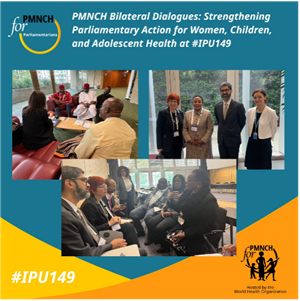 Additionally, discussions were held with delegations from 15 member parliaments. Through these meetings, PMNCH socialized the resolution on reducing maternal, newborn and child mortality, passed at the 77th World Health Assembly in May 2024 and secured inputs from parliamentarians on accelerating progress towards achieving SDG targets 3.1 and 3.2 by implementing and domesticating the resolution through parliamentary action. Furthermore, parliamentarians shared how PMNCH can support them to advocate strongly for WCAH issues including through provision of capacity building support, by engaging the institutional mechanisms and processes of parliaments, to support induction of new parliamentarians, sharing synthesized data, evidence and trends, and leveraging evidence generated from the commitment scoping and assessment reports developed by country partners, to name a few modalities. In addition, insightful lessons were learned on how to give visibility to WCAH issues through high level engagements in 2024, including those associated with the Global Leaders Network and alongside the COP29.
Actions arising from these rich discussions will be followed up in ensuing engagements, including the 34rd PMNCH Board Meeting (5th -6th December 2024) and leading up to the 150th IPU Assembly in Uzbekistan (5th – 9th April 2025).
The 4 prerogatives of parliaments – legislation, budgeting, oversight and representation are critical to ensuring progress on WCAH issues in the midst of compounding crisis. PMNCH’s pledges its solidarity and support to parliamentarians in support of their constitutional functions, through the power of its 10 constituencies ranging from UN Agencies to ART and Adolescents and Youth.